

SayStay Insights
Airbnb Is Changing the Rules. Who Owns the Guest Relationship?
New guest communication restrictions, evolving fees, and AI-powered messaging are raising an important question for independent hotels and property managers: How much control do you really have over your guest experience?
By Christon Scott
· 9 min read
Imagine a guest checking into your property at 9 PM. An hour later, the air conditioning stops working.
They reach for their phone to contact someone. But the communication channel they used to book is not necessarily the one your staff monitors. Their contact details may be restricted, your front desk may be closed, and the person who can resolve the issue may not know there's a problem.
By morning, what could have been a manageable service request has become a disappointing guest experience.
For independent hotel owners and property managers, this is more than a technology problem. It's a question of who controls the relationship with the guest, and who is responsible for making that guest feel looked after.
Recent changes at Airbnb are bringing that question into sharper focus.
Airbnb Is Changing How Hosts Communicate With Guests
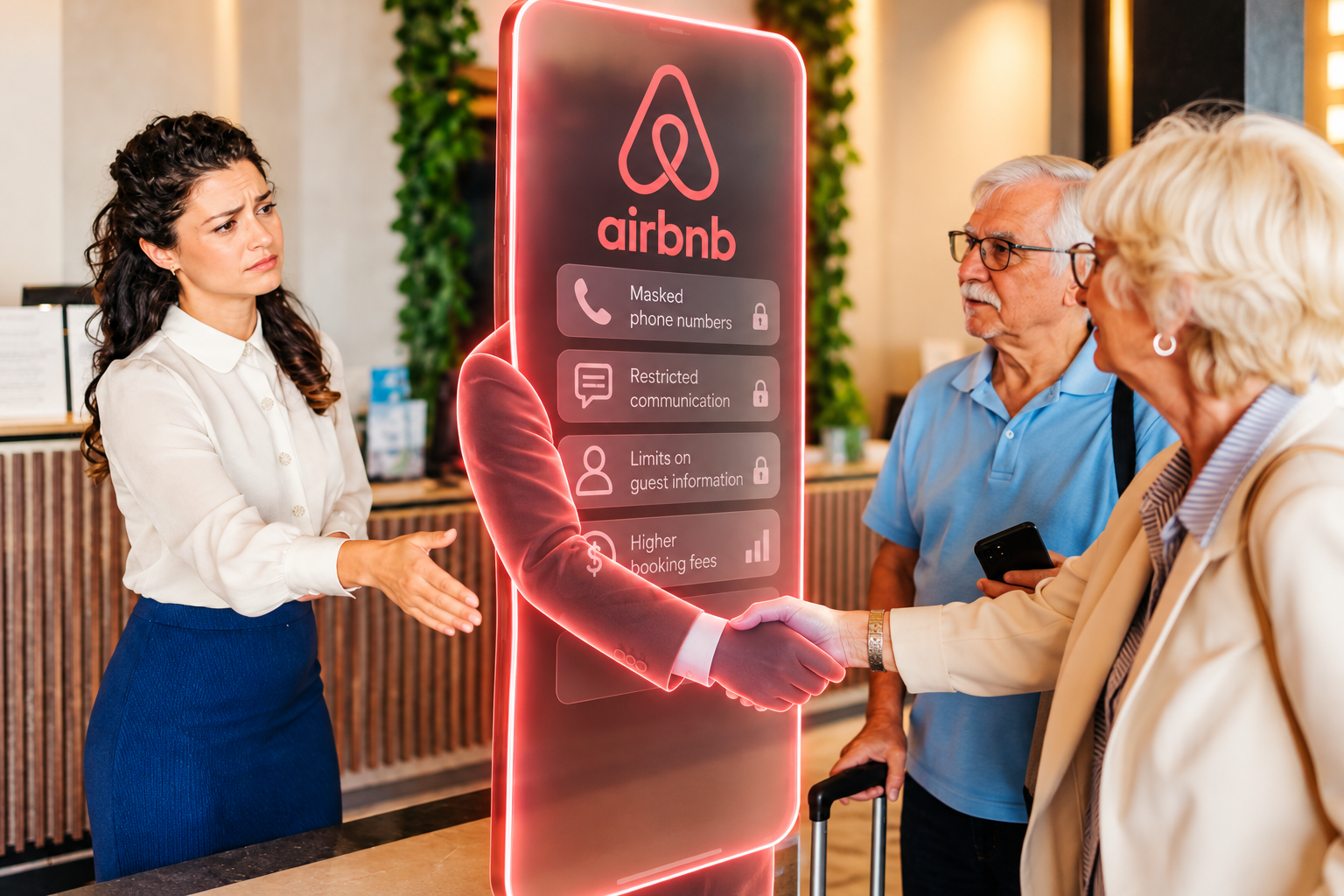
Airbnb is introducing changes that affect how some professional hosts access guest phone numbers and communicate outside its platform.
Beginning October 30, 2026, certain large, software-connected hosts in the United States and Canada will be affected by expanded phone-number masking.
Instead of exchanging their actual phone numbers, hosts and guests may communicate through temporary numbers. These support calls and SMS during a defined booking window, but they do not support WhatsApp or picture messaging.
The change does not apply to every Airbnb host or reservation. Nevertheless, it highlights an important operational reality: When a booking platform controls the communication channel, the property operator may have less flexibility in how it serves the guest.
Consider a property manager who uses automated SMS messages to provide check-in instructions, answer parking questions, and respond to maintenance requests. A temporary phone number may support some of those interactions, but it may not work with every messaging tool or workflow.
That doesn't mean the guest should receive a lower standard of service. It means the operator must think more carefully about how communication systems work together.
The Rules Around Guest Information Are Also Tightening
Airbnb is also updating its policies concerning guest information, separate agreements, and off-platform requirements.
Effective November 20, 2026, the updated rules generally restrict hosts from requiring guests to provide additional personal information or complete separate registration processes outside Airbnb, subject to specified exceptions.
Certain hotels and other properties may have legitimate reasons to collect information, including legal registration requirements. But operators should not assume that an Airbnb reservation automatically gives them permission to collect or use guest contact information for unrelated purposes.
For professional property managers, this introduces a distinction worth understanding.
A guest relationship and a guest's personal data are not the same thing.
You can provide exceptional hospitality to someone who booked through Airbnb without attempting to move their reservation off the platform or collect information you're not entitled to use.
At the same time, when a guest contacts your hotel directly through your website, email, or business phone number, you have an opportunity to build a relationship through channels your business manages, subject to the guest's preferences and applicable privacy rules.
The objective should not be to circumvent Airbnb's policies. It should be to build a hospitality business capable of serving guests well across multiple booking channels.
The Economics of Third-Party Bookings Are Changing Too
Guest communication is only part of the story.
Airbnb's standard single host service fee is now 15.5%, with certain exceptions. Software-connected hosts who had not already transitioned moved to the updated structure in October 2026.
For a property generating $100,000 in bookings subject to that fee, the platform charge would be $15,500.
That's a meaningful cost for an independent hospitality business.
Of course, direct bookings aren't free. Hotels must still pay for marketing, payment processing, technology, and customer service. And Airbnb provides something valuable: access to travelers who might never have discovered the property otherwise.
The question isn't whether hotels should abandon third-party platforms.
It's whether they should depend on those platforms for nearly every new guest relationship.
A healthier distribution strategy gives guests multiple ways to discover, contact, and book a property.
It also ensures that when someone visits the hotel's own website with a question about availability, room options, or a special request, that inquiry receives the attention it deserves.
An unanswered direct-booking inquiry can be a missed revenue opportunity just as surely as an unanswered complaint can become a service problem.
Airbnb Is Investing in AI. What Does That Mean for Independent Hotels?
Airbnb is also developing its own AI-powered guest communication capabilities.
Its tools increasingly help answer common questions, surface reservation information, and identify messages that may require attention.
This is a logical development. Travelers want fast answers, and property operators cannot always be available to respond immediately.
But there's an important distinction between AI that operates within a booking platform and AI that works on behalf of an individual hospitality business.
An independent hotel may receive inquiries through its website, email, SMS, WhatsApp, and third-party booking platforms. Its guests may have questions about room availability, parking, accessibility, nearby restaurants, early check-in, or an unexpected maintenance problem.
Those questions don't arrive neatly through a single channel.
And they don't stop when the front desk closes.
The opportunity for independent operators is to create a more consistent experience across the channels they control, while respecting the communication rules of the platforms they use.
The Real Competitive Advantage Is Making Guests Feel Looked After
Technology matters, but hospitality has always been about something more fundamental.
A guest arriving at an unfamiliar property wants reassurance.
They want to know where to park, how to get inside, whether the restaurant nearby is still open, and whom to contact if something goes wrong.
Ideally, they shouldn't have to struggle to find that information.
The best guest experience is one where someone seems to be looking after you, anticipating what you might need, and making help easy to find.
For a large hotel with a staffed front desk, delivering that experience may be relatively straightforward.
For a 14-room inn, a small guesthouse, or a property manager overseeing multiple locations, the challenge is different.
The owner may be handling reservations, housekeeping, maintenance, marketing, and accounting. Providing attentive service around the clock can become exhausting.
Yet guests don't necessarily adjust their expectations based on the property's staffing model.
They still expect to be heard.
This is where thoughtfully designed technology can make a meaningful difference.
The objective isn't to remove people from hospitality. It's to make personal hospitality possible without requiring the owner to be available every minute of the day.
Where SayStay Fits
At SayStay, we're building around a simple idea:
Every guest should feel that someone is looking after them, even when the owner or front desk isn't immediately available.
Our AI guest assistant, Joy, helps independent hotels respond to routine guest inquiries through supported channels including SMS, WhatsApp, and email.
Joy uses information provided by the property to answer questions about rooms, amenities, policies, and local recommendations.
For direct inquiries, SayStay can also help guests explore availability and booking options.
When a situation requires human judgment or intervention, Joy can escalate the issue to the owner or staff rather than pretending that every problem can be solved automatically.
Consider that guest whose air conditioning stops working at 10 PM.
The goal isn't for an AI assistant to diagnose and repair the system. It's to acknowledge the guest's concern, provide appropriate property-approved guidance, and bring the problem to the attention of someone who can help.
That first response matters.
So does what happens next.
For us, the long-term vision goes beyond answering questions. It's about helping properties anticipate common information needs so guests feel supported throughout their stay.
SayStay isn't a replacement for Airbnb, a property management system, or the people who make a hotel special.
It's an additional layer of guest communication and service for the channels and workflows a property can appropriately manage.
Independence Doesn't Mean Doing Everything Yourself
Airbnb and other booking platforms will remain important distribution partners for many hospitality businesses.
Their investments in AI may also improve the experience for guests booking through those platforms.
But independent operators should be thinking about what happens beyond the booking itself.
Who answers when a prospective guest contacts your website?
Who responds when an existing guest needs help after hours?
Who ensures that questions about parking, check-in, or local amenities receive accurate answers?
And who makes sure that an important concern reaches a real person before it becomes a larger problem?
Those questions are central to the guest experience, regardless of where the reservation originated.
The future of independent hospitality isn't about choosing between technology and personal service. It's about using technology to make personal service more consistent, responsive, and sustainable.
Airbnb may change its rules, fees, and communication tools.
But one thing remains within every hospitality operator's control: the commitment to make guests feel genuinely cared for.
That's the experience we're building SayStay to support.
Your Hotel. Your Guests. Your Independence.
Give guests the confidence that someone is there to help, while giving yourself more time to run your business.
SayStay helps independent hotels manage guest inquiries, direct-booking conversations, and service escalation through supported communication channels.
Sources and further reading
- Airbnb Help Center: Service fee structures and updates
- Airbnb Help Center: Off-platform and guest information policies
- Airbnb Help Center: Ground rules and checkout requirements
- Skift, October 27, 2026: Reporting on Airbnb's expanded guest phone-number masking
- Airbnb product announcements: AI-assisted guest messaging features
Editor's note: Airbnb policies vary by host type, property, geography, and software configuration. Operators should review the current policies applicable to their own listings and integrations.